 |
|
High-precision calculations for one- and two-valence atomic systems
|
|
|
High-precision calculations for one- and two-valence atomic systems
|
General tensor operator (virtual base class); all single-particle (one-body) tenosor operators derive from this.
Represents a single-particle (one-body) tensor operator \( \hat{h} \) of rank- \( k \) and parity \( \pi \), thats acts on Dirac spinors. The core quantity is the reduced matrix element (RME):
\[ \langle a \| \hat{h} \| b \rangle \equiv A_{ab} \cdot R_{ab} \]
where \( A_{ab} \) is the angular factor (see angularF()) and \( R_{ab} \) is the radial integral (see radialIntegral()).
The default radial integral is:
\[ R_{ab} = c \int_0^\infty v(r)\left( C_{ff}\,f_a f_b + C_{fg}\,f_a g_b + C_{gf}\,g_a f_b + C_{gg}\,g_a g_b \right)\,{\rm d}r \]
where \( c \) is an overall multiplicative constant (1 by default), \( v(r) \) is an optional radial function (stored in m_vec), and the \( C_{xy} \) are angular coefficients returned by angularCff() etc.
TensorOperator is a virtual base class and cannot be constructed directly.
Beyond that, there are two levels of customisation:
Implement angularF() (required), and optionally angularCff(), angularCgg(), angularCfg(), angularCgf(). The radial integral is then handled automatically by the default radial_rhs() and radialIntegral(). The \( v(r) \) radial function, and overall constant \( c \) are set within the constructor TensorOperator::TensorOperator(), which should be called by any deriving class. Then, the default radial integral as above will be used.
If the radial integral cannot be expressed in the above standard/default form (e.g., it involves derivatives, non-local terms, or more complicated radial structure), you shuold override radial_rhs() and radialIntegral() directly. In that case both should be consistent with each other:
radial_rhs(ka, Fb) returns the spinor \( \delta F_b \) such that
\[ F_a \cdot \delta F_b = R_{ab} \]
ampsci -o), add it to the operator_list in GenerateOperator.hpp and provide a corresponding generate_XYZ() factory function. #include <TensorOperator.hpp>
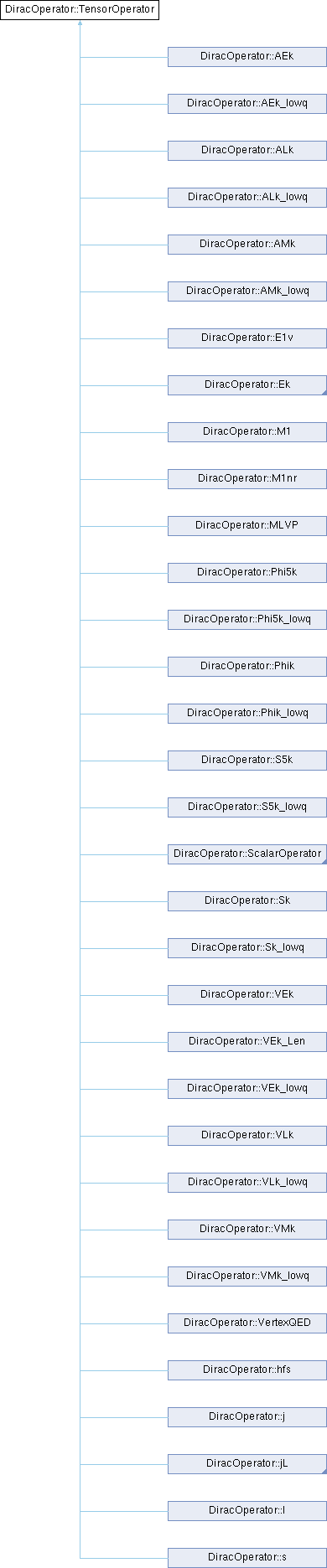
 Inheritance diagram for DiracOperator::TensorOperator:
Classes | |
| struct | Params |
| Used to pass generic parameters to update() function. More... | |
Public Member Functions | |
| TensorOperator (const TensorOperator &)=default | |
| TensorOperator & | operator= (const TensorOperator &)=default |
| TensorOperator (TensorOperator &&)=default | |
| TensorOperator & | operator= (TensorOperator &&)=default |
| bool | freqDependantQ () const |
| Returns true if the operator is frequency-dependent (requires updateFrequency() calls). | |
| double | h_minus_sign () const |
| Sign of the operator at -|omega| relative to that at +|omega|: h(-|omega|) = h_minus_sign() * h(+|omega|): -1 for an operator odd in the frequency (e.g. E1v), +1 otherwise (depends on |omega| only). So the operator need only ever be set at +|omega|; the emission (e^{+i omega t}) side carries this sign. | |
| double | omega () const |
| Returns the current frequency set by the last updateFrequency() call. Zero for frequency-independent operators. | |
| bool | isZero (int ka, int kb) const |
| Returns true if <a|h|b> = 0 by rank/parity selection rules. | |
| bool | isZero (const DiracSpinor &Fa, const DiracSpinor &Fb) const |
| Overload taking DiracSpinors; forwards to isZero(ka, kb). | |
| bool | selectrion_rule (int twoJA, int piA, int twoJB, int piB) const |
| Returns true if the matrix element is non-zero by angular momentum and parity selection rules (arguments are 2j and pi as integers). | |
| virtual void | updateFrequency (const double) |
| Updates the operator for a new frequency omega. | |
| virtual void | updateRank (int) |
| const std::vector< double > & | getv () const |
| Returns a const ref to the stored vector v. | |
| double | getc () const |
| Returns the "overall" constant c. | |
| bool | imaginaryQ () const |
| returns true if operator is imaginary (has imag MEs) | |
| int | rank () const |
| Rank k of operator. | |
| int | parity () const |
| returns parity, as integer (+1 or -1) | |
| int | symm_sign (const DiracSpinor &Fa, const DiracSpinor &Fb) const |
| returns relative sign between <a||x||b> and <b||x||a> | |
| virtual std::string | name () const |
| Returns "name" of operator (e.g., 'E1') | |
| virtual std::string | units () const |
| Returns units of operator as a string (usually au, may be MHz, etc.) | |
| virtual double | angularCff (int kappa_a, int kappa_b) const |
| Angular coefficient C_ff for the f_a*f_b term of the radial integral. | |
| virtual double | angularCgg (int, int) const |
| Angular coefficient C_gg for the g_a*g_b term of the radial integral. | |
| virtual double | angularCfg (int, int) const |
| Angular coefficient C_fg for the f_a*g_b term of the radial integral. | |
| virtual double | angularCgf (int, int) const |
| Angular coefficient C_gf for the g_a*f_b term of the radial integral. | |
| double | angularCxy (uint8_t x, uint8_t y, int kappa_a, int kappa_b) const |
| Dispatches to angularCff/fg/gf/gg based on component indices x, y. | |
| virtual double | angularF (const int, const int) const =0 |
| Angular factor A_ab linking the radial integral to the RME. | |
| virtual std::unique_ptr< TensorOperator > | clone () const |
| Creates a polymorphic copy of the operator at its current state, or nullptr if cloning is not supported by the derived class. | |
| virtual DiracSpinor | radial_rhs (const int kappa_a, const DiracSpinor &Fb) const |
| Computes the right-hand spinor dF_b for the radial integral. | |
| virtual double | radialIntegral (const DiracSpinor &Fa, const DiracSpinor &Fb) const |
| Radial integral R_ab, defined by RME = angularF(a,b) * radialIntegral(a,b). | |
| double | rme3js (int twoja, int twojb, int two_mb=1, int two_q=0) const |
| 3j-symbol factor linking the full ME to the RME. | |
| double | rme3js (const DiracSpinor &Fa, const DiracSpinor &Fb, int two_mb=1, int two_q=0) const |
| Overload of rme3js taking DiracSpinors. | |
| DiracSpinor | reduced_rhs (const int ka, const DiracSpinor &Fb) const |
| Returns angularF(ka,kb) * radial_rhs(ka,Fb); spinor-valued RME action on Fb, used in perturbation theory/TDHF. | |
| DiracSpinor | reduced_lhs (const int ka, const DiracSpinor &Fb) const |
| As reduced_rhs but for the conjugate direction; Fb * reduced_lhs(ka, Fb) = <b||h||a>. | |
| double | reducedME (const DiracSpinor &Fa, const DiracSpinor &Fb) const |
| Returns the reduced matrix element <a||h||b> = A_ab * R_ab. | |
| double | fullME (const DiracSpinor &Fa, const DiracSpinor &Fb, std::optional< int > two_ma=std::nullopt, std::optional< int > two_mb=std::nullopt, std::optional< int > two_q=std::nullopt) const |
| Returns "full" matrix element, for optional (ma, mb, q) [taken as int 2*]. If not specified, returns z-component (q=0), with ma=mb=min(ja,jb) | |
| double | matel_factor (MatrixElementType type, int twoJa, int twoJb) const |
| Returns the factor to convert a reduced ME to a different form (Reduced, Stretched, or HFConstant); see MatrixElementType. | |
| double | matel_factor (MatrixElementType type, const DiracSpinor &Fa, const DiracSpinor &Fb) const |
| Overload of matel_factor taking DiracSpinors. | |
Protected Member Functions | |
| TensorOperator (int rank_k, Parity pi, double constant=1.0, const std::vector< double > &vec={}, Realness RorI=Realness::real, bool freq_dep=false, bool odd_in_omega=false) | |
| Constructs a specific tensor operator. Called by derived classes. | |
Protected Attributes | |
| int | m_rank |
| Parity | m_parity |
| Realness | m_Realness |
| bool | m_freqDependantQ {false} |
| bool | m_oddInOmegaQ {false} |
| double | m_constant |
| std::vector< double > | m_vec |
| double | m_omega {0.0} |
|
inlineprotected |
Constructs a specific tensor operator. Called by derived classes.
Initialises the basic properties of a tensor operator.
| rank_k | Tensor rank k of the operator. |
| pi | Parity of the operator (Parity::even or Parity::odd). |
| constant | Multiplicative constant c, included in the radial integral. |
| vec | Overall v=f(r) radial function, as std::vector. May be impty, in which case it is not used (equivilant to vector of 1) |
| RorI | Specifies whether the matrix element is real or imaginary (Realness::real or Realness::imaginary). |
| freq_dep | Indicates whether the operator depends on frequency (e.g., dynamic external fields). |
|
inline |
Returns true if the operator is frequency-dependent (requires updateFrequency() calls).
|
inline |
Sign of the operator at -|omega| relative to that at +|omega|: h(-|omega|) = h_minus_sign() * h(+|omega|): -1 for an operator odd in the frequency (e.g. E1v), +1 otherwise (depends on |omega| only). So the operator need only ever be set at +|omega|; the emission (e^{+i omega t}) side carries this sign.
|
inline |
Returns the current frequency set by the last updateFrequency() call. Zero for frequency-independent operators.
| bool DiracOperator::TensorOperator::isZero | ( | int | ka, |
| int | kb | ||
| ) | const |
Returns true if <a|h|b> = 0 by rank/parity selection rules.
| bool DiracOperator::TensorOperator::isZero | ( | const DiracSpinor & | Fa, |
| const DiracSpinor & | Fb | ||
| ) | const |
Overload taking DiracSpinors; forwards to isZero(ka, kb).
|
inline |
Returns true if the matrix element is non-zero by angular momentum and parity selection rules (arguments are 2j and pi as integers).
|
inlinevirtual |
Updates the operator for a new frequency omega.
Must be overridden by any frequency-dependent operator (i.e., where freqDependantQ() returns true). Called before computing matrix elements whenever the frequency changes. Does nothing for a frequency-independent operator, so may be called on any operator.
The base class implementation aborts for a frequency-dependent operator: if freq_dep=true is set but this function is not overridden, it will abort at runtime when called.
| omega | Frequency in atomic units. |
m_omega = omega so that omega() reflects the current frequency. Reimplemented in DiracOperator::VEk_Len, DiracOperator::VEk, DiracOperator::VLk, DiracOperator::VMk, DiracOperator::Phik, DiracOperator::Sk, DiracOperator::AEk, DiracOperator::ALk, DiracOperator::AMk, DiracOperator::Phi5k, DiracOperator::S5k, DiracOperator::VMk_lowq, DiracOperator::Phik_lowq, DiracOperator::Sk_lowq, DiracOperator::AEk_lowq, DiracOperator::ALk_lowq, DiracOperator::AMk_lowq, DiracOperator::Phi5k_lowq, DiracOperator::S5k_lowq, DiracOperator::M1, DiracOperator::VEk_lowq, and DiracOperator::VLk_lowq.
|
inlinevirtual |
Updates the rank of operator (rarely used). Generally also updates parity
Use with caution.
Reimplemented in DiracOperator::EM_multipole.
|
inline |
Returns a const ref to the stored vector v.
|
inline |
Returns the "overall" constant c.
|
inline |
returns true if operator is imaginary (has imag MEs)
|
inline |
Rank k of operator.
|
inline |
returns parity, as integer (+1 or -1)
|
inline |
returns relative sign between <a||x||b> and <b||x||a>
|
inlinevirtual |
Returns "name" of operator (e.g., 'E1')
Reimplemented in DiracOperator::Ek, DiracOperator::EM_multipole, DiracOperator::fieldshift, DiracOperator::jL, DiracOperator::j, DiracOperator::l, DiracOperator::s, DiracOperator::sigma_r, DiracOperator::E1v, DiracOperator::hfs, DiracOperator::g0jL, DiracOperator::ig5jL, DiracOperator::ig0g5jL, DiracOperator::M1, DiracOperator::M1nr, DiracOperator::p, DiracOperator::PNCnsi, DiracOperator::Vrad, DiracOperator::VertexQED, DiracOperator::MLVP, and DiracOperator::RadialF.
|
inlinevirtual |
Returns units of operator as a string (usually au, may be MHz, etc.)
Reimplemented in DiracOperator::Ek, DiracOperator::fieldshift, DiracOperator::j, DiracOperator::l, DiracOperator::s, DiracOperator::sigma_r, DiracOperator::E1v, DiracOperator::hfs, DiracOperator::jL, DiracOperator::M1, DiracOperator::M1nr, DiracOperator::p, DiracOperator::PNCnsi, DiracOperator::Vrad, DiracOperator::VertexQED, DiracOperator::MLVP, and DiracOperator::RadialF.
|
inlinevirtual |
Angular coefficient C_ff for the f_a*f_b term of the radial integral.
The default radial integral is structured as:
\[ R_{ab} = c\int_0^\infty v(r)\left( C_{ff}\,f_a f_b + C_{fg}\,f_a g_b + C_{gf}\,g_a f_b + C_{gg}\,g_a g_b \right)\,{\rm d}r \]
These coefficients are often constants, but may depend on \( \kappa_a, \kappa_b \) for operators with angular-momentum-dependent coupling between large and small components (e.g., spin-dependent operators). Override in derived classes as needed.
| kappa_a | kappa \( \kappa_a \) for left-hand-side (bra) |
| kappa_b | kappa \( \kappa_b \) for right-hand-side (ket) |
Reimplemented in DiracOperator::VertexQED, DiracOperator::MLVP, DiracOperator::jL, DiracOperator::ig0g5jL, DiracOperator::ScalarOperator, DiracOperator::E1v, DiracOperator::VEk_lowq, DiracOperator::VMk_lowq, DiracOperator::VLk_lowq, DiracOperator::hfs, DiracOperator::g0jL, DiracOperator::ig5jL, DiracOperator::M1, DiracOperator::p, and DiracOperator::NullOperator.
|
inlinevirtual |
Angular coefficient C_gg for the g_a*g_b term of the radial integral.
Reimplemented in DiracOperator::VertexQED, DiracOperator::MLVP, DiracOperator::jL, DiracOperator::ig0g5jL, DiracOperator::ScalarOperator, DiracOperator::E1v, DiracOperator::VEk_lowq, DiracOperator::VMk_lowq, DiracOperator::VLk_lowq, DiracOperator::hfs, DiracOperator::g0jL, DiracOperator::ig5jL, DiracOperator::M1, DiracOperator::p, and DiracOperator::NullOperator.
|
inlinevirtual |
Angular coefficient C_fg for the f_a*g_b term of the radial integral.
Reimplemented in DiracOperator::E1v, DiracOperator::VEk_lowq, DiracOperator::VLk_lowq, DiracOperator::VertexQED, DiracOperator::MLVP, DiracOperator::jL, DiracOperator::ig0g5jL, DiracOperator::ScalarOperator, DiracOperator::VMk_lowq, DiracOperator::hfs, DiracOperator::g0jL, DiracOperator::ig5jL, DiracOperator::M1, DiracOperator::p, and DiracOperator::NullOperator.
|
inlinevirtual |
Angular coefficient C_gf for the g_a*f_b term of the radial integral.
Reimplemented in DiracOperator::E1v, DiracOperator::VEk_lowq, DiracOperator::VLk_lowq, DiracOperator::VertexQED, DiracOperator::MLVP, DiracOperator::jL, DiracOperator::ig0g5jL, DiracOperator::ScalarOperator, DiracOperator::VMk_lowq, DiracOperator::hfs, DiracOperator::g0jL, DiracOperator::ig5jL, DiracOperator::M1, DiracOperator::p, and DiracOperator::NullOperator.
|
inline |
Dispatches to angularCff/fg/gf/gg based on component indices x, y.
Convenience dispatcher: x and y index the spinor component (0 = large/f, 1 = small/g) of the bra and ket respectively, and returns the corresponding angular coefficient C_xy(ka, kb).
See angularCff()
| x | y | returns |
|---|---|---|
| 0 | 0 | angularCff() |
| 0 | 1 | angularCfg() |
| 1 | 0 | angularCgf() |
| 1 | 1 | angularCgg() |
| x | Bra component index: 0=f (large), 1=g (small). |
| y | Ket component index: 0=f (large), 1=g (small). |
| kappa_a | kappa \( \kappa_a \) for left-hand-side (bra) |
| kappa_b | kappa \( \kappa_b \) for right-hand-side (ket) |
|
pure virtual |
Angular factor A_ab linking the radial integral to the RME.
All derived operators must implement this. It gives the purely angular part of the reduced matrix element:
\[ \langle a \| \hat{h} \| b \rangle \equiv A_{ab} \cdot R_{ab} \]
where \( R_{ab} \) is returned by radialIntegral(). For most operators, \( A_{ab} \) is a product of Clebsch-Gordan / 3j coefficients and depends only on \( \kappa_a, \kappa_b \) (and the rank \( k \) and parity \( \pi \) of the operator).
Implemented in DiracOperator::EM_multipole, DiracOperator::jL, DiracOperator::ig0g5jL, DiracOperator::ScalarOperator, DiracOperator::Ek, DiracOperator::E1v, DiracOperator::VMk_lowq, DiracOperator::hfs, DiracOperator::ig5jL, DiracOperator::j, DiracOperator::l, DiracOperator::s, DiracOperator::M1, DiracOperator::p, DiracOperator::VertexQED, DiracOperator::MLVP, and DiracOperator::M1nr.
|
inlinevirtual |
Creates a polymorphic copy of the operator at its current state, or nullptr if cloning is not supported by the derived class.
Frequency-dependent operators must override this so the TDHF solver can construct an independent \( t_- = t_+^\dagger(-\omega) \) operator.
Most operators can implement this as a one-liner using the copy constructor:
This works whenever the copy constructor correctly preserves all state, including m_vec, m_constant, and m_omega.
Reimplemented in DiracOperator::Ek, DiracOperator::EM_multipole, DiracOperator::E1, DiracOperator::sigma_r, DiracOperator::E1v, DiracOperator::fieldshift, DiracOperator::hfs, DiracOperator::j, DiracOperator::l, DiracOperator::s, DiracOperator::M1, DiracOperator::M1nr, DiracOperator::p, DiracOperator::PNCnsi, DiracOperator::Vrad, DiracOperator::MLVP, and DiracOperator::RadialF.
|
virtual |
Computes the right-hand spinor dF_b for the radial integral.
Returns \( \delta F_b \) such that the radial integral satisfies:
\[ R_{ab} = F_a \cdot \delta F_b = \int_0^\infty \left(f_a\,\delta f_b + g_a\,\delta g_b\right)\,{\rm d}r \]
The default implementation constructs \( \delta F_b \) using the stored radial function \( v(r) \) and the angular coefficients:
\[ \delta F_b(r) = c\,v(r) \begin{pmatrix} C_{ff}\,f_b(r) + C_{fg}\,g_b(r) \\ C_{gf}\,f_b(r) + C_{gg}\,g_b(r) \end{pmatrix} \]
This is used by reduced_rhs() to build \( \langle a \| \hat{h} \| b \rangle \) as a spinor-valued quantity, enabling perturbation theory and TDHF. Override this for operators whose radial structure cannot be expressed in this standard form.
| kappa_a | Relativistic quantum number \( \kappa_a \) of the bra state (needed to evaluate the angular coefficients). |
| Fb | Ket DiracSpinor \( F_b \) . |
Reimplemented in DiracOperator::jL, DiracOperator::VEk_Len, DiracOperator::VEk, DiracOperator::VLk, DiracOperator::VMk, DiracOperator::Phik, DiracOperator::Sk, DiracOperator::AEk, DiracOperator::ALk, DiracOperator::AMk, DiracOperator::Phi5k, DiracOperator::S5k, DiracOperator::Phik_lowq, DiracOperator::Sk_lowq, DiracOperator::AEk_lowq, DiracOperator::ALk_lowq, DiracOperator::AMk_lowq, DiracOperator::Phi5k_lowq, DiracOperator::S5k_lowq, DiracOperator::M1nr, DiracOperator::p, and DiracOperator::Vrad.
|
virtual |
Radial integral R_ab, defined by RME = angularF(a,b) * radialIntegral(a,b).
Returns the radial part \( R_{ab} \) of the reduced matrix element:
\[ \langle a \| \hat{h} \| b \rangle = A_{ab} \cdot R_{ab} \]
where \( A_{ab} \) is angularF().
The default implementation evaluates \( R_{ab} = F_a \cdot \delta F_b \) , using the default radial structure:
\[ R_{ab} = c\int_0^\infty v(r)\left( C_{ff}\,f_a f_b + C_{fg}\,f_a g_b + C_{gf}\,g_a f_b + C_{gg}\,g_a g_b \right)\,{\rm d}r \]
Override this for operators that do not fit this standard form. If radial_rhs() is also overridden, both must remain mutually consistent.
Reimplemented in DiracOperator::VEk_Len, DiracOperator::VEk, DiracOperator::VLk, DiracOperator::VMk, DiracOperator::Phik, DiracOperator::Sk, DiracOperator::AEk, DiracOperator::ALk, DiracOperator::AMk, DiracOperator::Phi5k, DiracOperator::S5k, DiracOperator::Phik_lowq, DiracOperator::Sk_lowq, DiracOperator::AEk_lowq, DiracOperator::ALk_lowq, DiracOperator::AMk_lowq, DiracOperator::Phi5k_lowq, DiracOperator::S5k_lowq, DiracOperator::jL, DiracOperator::M1nr, DiracOperator::p, and DiracOperator::Vrad.
| double DiracOperator::TensorOperator::rme3js | ( | int | twoja, |
| int | twojb, | ||
| int | two_mb = 1, |
||
| int | two_q = 0 |
||
| ) | const |
3j-symbol factor linking the full ME to the RME.
\[ (-1)^{j_a - m_a} \begin{pmatrix} j_a & k & j_b \\ -m_a & q & m_b \end{pmatrix} \]
such that \(\langle a | \hat{h} | b \rangle = {\rm rme3js} \times \langle a \| \hat{h} \| b \rangle\). All arguments are twice the actual value (2*j, 2*m, 2*q).
|
inline |
Overload of rme3js taking DiracSpinors.
| DiracSpinor DiracOperator::TensorOperator::reduced_rhs | ( | const int | ka, |
| const DiracSpinor & | Fb | ||
| ) | const |
Returns angularF(ka,kb) * radial_rhs(ka,Fb); spinor-valued RME action on Fb, used in perturbation theory/TDHF.
| DiracSpinor DiracOperator::TensorOperator::reduced_lhs | ( | const int | ka, |
| const DiracSpinor & | Fb | ||
| ) | const |
As reduced_rhs but for the conjugate direction; Fb * reduced_lhs(ka, Fb) = <b||h||a>.
| double DiracOperator::TensorOperator::reducedME | ( | const DiracSpinor & | Fa, |
| const DiracSpinor & | Fb | ||
| ) | const |
Returns the reduced matrix element <a||h||b> = A_ab * R_ab.
| double DiracOperator::TensorOperator::fullME | ( | const DiracSpinor & | Fa, |
| const DiracSpinor & | Fb, | ||
| std::optional< int > | two_ma = std::nullopt, |
||
| std::optional< int > | two_mb = std::nullopt, |
||
| std::optional< int > | two_q = std::nullopt |
||
| ) | const |
Returns "full" matrix element, for optional (ma, mb, q) [taken as int 2*]. If not specified, returns z-component (q=0), with ma=mb=min(ja,jb)
| double DiracOperator::TensorOperator::matel_factor | ( | MatrixElementType | type, |
| int | twoJa, | ||
| int | twoJb | ||
| ) | const |
Returns the factor to convert a reduced ME to a different form (Reduced, Stretched, or HFConstant); see MatrixElementType.
|
inline |
Overload of matel_factor taking DiracSpinors.
 1.9.8
1.9.8