 |
|
High-precision calculations for one- and two-valence atomic systems
|
|
|
High-precision calculations for one- and two-valence atomic systems
|
Uses TDHF to include core-polarisation (RPA) corrections to matrix elements of an external field operator.
Solves the TDHF equations for each core orbital \( \phi_a \),
\[ (h_{\rm HF} - \en_a \mp \omega)\varphi^a_\pm = -(t_\pm + \delta V_\pm - \delta\en^a_\pm)\phi_a, \]
self-consistently to determine \( \delta V_\pm \). See the ExternalField namespace documentation for full physics description.
Each core orbital acquires both a forward ( \( \varphi^a_+ \), stored as X) and backward ( \( \varphi^a_- \), stored as Y) correction. Both contribute to \( \delta V_\pm \):
\[ \delta V_\pm \phi_i = \sum_a^{\rm core} \left[ \matel{\phi_a}{Q}{\varphi^a_+}\phi_i - \matel{\phi_a}{Q}{\phi_i}\varphi^a_+ + \matel{\varphi^a_-}{Q}{\phi_a}\phi_i - \matel{\varphi^a_-}{Q}{\phi_i}\phi_a \right]. \]
It is via \( \delta V_\pm \) that the \( e^{\pm i\omega t} \) terms are mixed.
#include <TDHF.hpp>
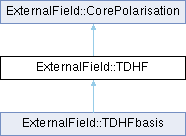
 Inheritance diagram for ExternalField::TDHF:
Public Member Functions | |
| TDHF (const DiracOperator::TensorOperator *const h_plus, const HF::HartreeFock *const hf) | |
| Constructs TDHF for operator h. | |
| virtual void | solve_core (double omega, int max_its=100, bool print=true) override |
| Solves TDHF equations self-consistently for core electrons at frequency omega. | |
| void | solve_core_damped (double omega, int max_its=128, bool print=true) |
| As solve_core(), by damped iteration only (no fallback). | |
| void | solve_core_anderson (double omega, int max_its=128, bool print=true) |
| As solve_core(), by Anderson mixing only (no fallback). | |
| void | set_anderson (bool andersonQ) |
| Method of solve_core(): Anderson mixing if true (default), damped iteration if false; the other is the fallback. | |
| virtual Method | method () const override |
| Returns RPA method. | |
| virtual void | clear () override |
| Clears the internal state back to pre solve_core() | |
| double | dV (const DiracSpinor &Fa, const DiracSpinor &Fb, bool conj=false) const override |
| Returns reduced matrix element <a||dV||b>, or the conjugate <a||dV^dag||b> if conj=true. | |
| DiracSpinor | dV_rhs (int kappa_n, const DiracSpinor &Fm, bool conj=false) const override |
| Returns [dV_pm * phi_m]_kappa: RHS of TDHF eq., projected onto kappa (see namespace doc) | |
| const std::vector< DiracSpinor > & | get_dPsis (const DiracSpinor &Fc, dPsiType XorY) const |
| Returns const ref to dPsi orbitals for given core orbital Fc. | |
| const DiracSpinor & | get_dPsi_x (const DiracSpinor &Fc, dPsiType XorY, const int kappa_x) const |
| Returns const ref to dPsi orbital of given kappa. | |
| DiracSpinor | solve_dPsi (const DiracSpinor &Fv, const double omega, dPsiType XorY, const int kappa_beta, const MBPT::CorrelationPotential *const Sigma=nullptr, StateType st=StateType::ket, bool incl_dV=true) const |
| Forms the mixed states phi^v_+- for valence state Fv (including core pol.): single kappa channel. | |
| std::vector< DiracSpinor > | solve_dPsis (const DiracSpinor &Fv, const double omega, dPsiType XorY, const MBPT::CorrelationPotential *const Sigma=nullptr, StateType st=StateType::ket, bool incl_dV=true) const |
| Forms the mixed states phi^v_+- for all kappa channels; see solve_dPsi. | |
| TDHF & | operator= (const TDHF &)=delete |
| TDHF (const TDHF &)=default | |
| Public Member Functions inherited from ExternalField::CorePolarisation | |
| double | last_eps () const |
| Returns eps (convergance) of last solve_core run. | |
| double | last_its () const |
| Returns its (# of iterations) of last solve_core run. | |
| double | last_omega () const |
| Returns omega (frequency) of last solve_core run. | |
| int | rank () const |
| Rank of the operator. | |
| int | parity () const |
| Parity of the operator. | |
| bool | imagQ () const |
| Returns true if the operator is imaginary. | |
| double & | eps_target () |
| Convergance target. | |
| double | eps_target () const |
| Convergance target. | |
| double | eta () const |
| Damping factor; 0 means no damping. Must have 0 <= eta < 1. | |
| void | set_eta (double eta) |
| Set/update damping factor; 0 means no damping. Must have 0 <= eta < 1. | |
| CorePolarisation & | operator= (const CorePolarisation &)=delete |
| CorePolarisation (const CorePolarisation &)=default | |
Protected Member Functions | |
| std::vector< std::vector< DiracSpinor > > | form_hFcore (const DiracOperator::TensorOperator *h) const |
| std::vector< std::vector< DiracSpinor > > | form_hFcore_minus (const std::vector< std::vector< DiracSpinor > > &hFcore) const |
| DiracSpinor | dV_rhs_sets (int kappa_n, const DiracSpinor &Fa, bool conj, const std::vector< std::vector< DiracSpinor > > &X, const std::vector< std::vector< DiracSpinor > > &Y) const |
| Protected Member Functions inherited from ExternalField::CorePolarisation | |
| CorePolarisation (const DiracOperator::TensorOperator *const h) | |
Protected Attributes | |
| std::vector< std::vector< DiracSpinor > > | m_X {} |
| std::vector< std::vector< DiracSpinor > > | m_Y {} |
| std::vector< std::vector< DiracSpinor > > | m_hFcore {} |
| std::vector< std::vector< DiracSpinor > > | m_hFcore_minus {} |
| const HF::HartreeFock *const | p_hf |
| const std::vector< DiracSpinor > | m_core |
| const double | m_alpha |
| const HF::Breit *const | p_VBr |
| bool | m_eps_sqrt {false} |
| bool | m_use_anderson {true} |
| bool | m_use_anderson_ms {true} |
| Protected Attributes inherited from ExternalField::CorePolarisation | |
| const DiracOperator::TensorOperator * | m_h |
| double | m_core_eps {1.0} |
| int | m_core_its {0} |
| double | m_core_omega {0.0} |
| int | m_rank |
| int | m_pi |
| bool | m_imag |
| double | m_eta {0.35} |
| double | m_eps {1.0e-15} |
| ExternalField::TDHF::TDHF | ( | const DiracOperator::TensorOperator *const | h_plus, |
| const HF::HartreeFock *const | hf | ||
| ) |
Constructs TDHF for operator h.
| h_plus | The operator \( t_+ \); must be set to positive frequency before each call to solve_core(). |
| hf | HF::HartreeFock object defining the core. |
|
overridevirtual |
Solves TDHF equations self-consistently for core electrons at frequency omega.
Iterates the TDHF equations until \( \delta V_\pm \) converges to within eps_target(), or max_its iterations have been performed. Can be re-run at a different frequency without restarting from scratch.
Solved by solve_core_anderson() (default) or solve_core_damped(). If that does not converge, the solve is started again from scratch with the other method, and the better result is kept.
| omega | External-field frequency \( \omega \) in atomic units. |
| max_its | Maximum number of iterations. Set to 1 to get the first-order correction (no damping on first iteration). |
| If true, write convergence progress to screen. |
Implements ExternalField::CorePolarisation.
Reimplemented in ExternalField::TDHFbasis, and ExternalField::TDHFcntm.
| void ExternalField::TDHF::solve_core_damped | ( | double | omega, |
| int | max_its = 128, |
||
| bool | print = true |
||
| ) |
As solve_core(), by damped iteration only (no fallback).
Each iteration mixes the new corrections with the previous ones, with damping factor eta().
| void ExternalField::TDHF::solve_core_anderson | ( | double | omega, |
| int | max_its = 128, |
||
| bool | print = true |
||
| ) |
As solve_core(), by Anderson mixing only (no fallback).
Self-consistency is driven by Anderson mixing (anderson_coefficients) of all the corrections together, X and Y. Each iteration applies the TDHF map undamped, then extrapolates over the recent iterates. The TDHF equations are linear in the corrections, so this is equivalent to truncated GMRES: there is no damping parameter, and it converges wherever the equations are non-singular.
|
inline |
Method of solve_core(): Anderson mixing if true (default), damped iteration if false; the other is the fallback.
|
inlineoverridevirtual |
Returns RPA method.
Implements ExternalField::CorePolarisation.
Reimplemented in ExternalField::TDHFbasis, and ExternalField::TDHFcntm.
|
overridevirtual |
Clears the internal state back to pre solve_core()
Implements ExternalField::CorePolarisation.
Reimplemented in ExternalField::TDHFcntm.
|
overridevirtual |
Returns reduced matrix element <a||dV||b>, or the conjugate <a||dV^dag||b> if conj=true.
Implements ExternalField::CorePolarisation.
Reimplemented in ExternalField::TDHFcntm.
|
overridevirtual |
Returns [dV_pm * phi_m]_kappa: RHS of TDHF eq., projected onto kappa (see namespace doc)
Reimplemented from ExternalField::CorePolarisation.
| const std::vector< DiracSpinor > & ExternalField::TDHF::get_dPsis | ( | const DiracSpinor & | Fc, |
| dPsiType | XorY | ||
| ) | const |
Returns const ref to dPsi orbitals for given core orbital Fc.
| const DiracSpinor & ExternalField::TDHF::get_dPsi_x | ( | const DiracSpinor & | Fc, |
| dPsiType | XorY, | ||
| const int | kappa_x | ||
| ) | const |
Returns const ref to dPsi orbital of given kappa.
| DiracSpinor ExternalField::TDHF::solve_dPsi | ( | const DiracSpinor & | Fv, |
| const double | omega, | ||
| dPsiType | XorY, | ||
| const int | kappa_beta, | ||
| const MBPT::CorrelationPotential *const | Sigma = nullptr, |
||
| StateType | st = StateType::ket, |
||
| bool | incl_dV = true |
||
| ) | const |
Forms the mixed states phi^v_+- for valence state Fv (including core pol.): single kappa channel.
Solves
\[ (h_{\rm HF} + \Sigma - \en_v - \omega)\varphi^v_+ = -(t + \delta V - \delta\en^v)\phi_v \]
or
\[ (h_{\rm HF} + \Sigma - \en_v + \omega)\varphi^v_- = -(t^\dagger + \delta V^\dagger - \delta\en^v)\phi_v \]
Returns \( \chi_\beta \) for given kappa_beta, where
\[ X_{j,m} = (-1)^{j_\beta-m}tjs(j,k,j;-m,0,m)\chi_j \]
| Fv | Valence state \(\phi_v\). |
| omega | Perturbation frequency \(\omega\). |
| XorY | Selects X or Y solution; see dPsiType. |
| kappa_beta | Kappa quantum number of the target channel. |
| Sigma | Optional correlation potential; see MBPT::CorrelationPotential. |
| st | Bra or ket convention; see StateType. |
| incl_dV | Include the induced potential \(\delta V\) if true. |
| std::vector< DiracSpinor > ExternalField::TDHF::solve_dPsis | ( | const DiracSpinor & | Fv, |
| const double | omega, | ||
| dPsiType | XorY, | ||
| const MBPT::CorrelationPotential *const | Sigma = nullptr, |
||
| StateType | st = StateType::ket, |
||
| bool | incl_dV = true |
||
| ) | const |
Forms the mixed states phi^v_+- for all kappa channels; see solve_dPsi.
 1.9.8
1.9.8