 |
|
High-precision calculations for one- and two-valence atomic systems
|
|
|
High-precision calculations for one- and two-valence atomic systems
|
TDHF (RPA) core polarisation above ionisation threshold(s): the open channels are solved with the outgoing-wave boundary condition, so the corrections and the corrected matrix elements are complex.
As TDHF, for a frequency above the ionisation threshold of one or more core orbitals,
\[ \en^a_+ = \en_a + \omega > 0. \]
Every X (+) channel of such an orbital is open, and describes the ejected electron. For it, the solution of the TDHF equation regular at the origin is not unique (the continuum orbital at en_+ may be added freely); the physical solution is the purely outgoing wave at large r, which is complex.
All other channels (closed orbitals, and every Y (-) partner) are bound, and are solved as in TDHF. Through dV every correction is complex: the real and imaginary parts are stored as separate sets (m_X, m_Y and m_Xi, m_Yi) and iterated together. Below every threshold the imaginary sets are exactly zero and the class reproduces TDHF.
In dV the (-) corrections enter as complex conjugates, so the Y sets store \( (\varphi_-)^* \) and the (real-linear) dV builder of TDHF applies to each set unchanged; the external field drives the real set only, and the two sets couple solely through the outgoing boundary condition.
With the real regular and irregular solutions F_reg, F_irr of the local channel Hamiltonian at en_+ (F_reg + i F_irr is outgoing), the standing-wave solve returns \( \varphi_P \to K F_{\rm irr} \), and the outgoing solution is \( \varphi_+ = \varphi_P - iK F_{\rm reg} \).
With the non-local exchange iterated in the source, F_reg is replaced by the exchange-dressed regular solution \( F^{\rm HF} \to F_{\rm reg} + K_{\rm ex} F_{\rm irr} \) (built once per channel per omega), and
\[ K_+ = \frac{K}{1 + iK_{\rm ex}}, \]
and
\[ \varphi_+ = \varphi_P - iK_+F^{\rm HF} \to -iK_+\left(F_{\rm reg} + iF_{\rm irr}\right). \]
For a complex source, phi_P is two real standing-wave solves (solveContinuumMixedState).
#include <TDHFcntm.hpp>
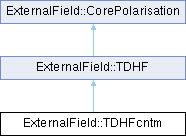
 Inheritance diagram for ExternalField::TDHFcntm:
Classes | |
| struct | Channel |
| Open channel: core-orbital index, ejected-electron kappa, and its energy en = en_a + omega. More... | |
Public Member Functions | |
| TDHFcntm (const DiracOperator::TensorOperator *const h, const HF::HartreeFock *const hf) | |
| Constructs for operator h; see TDHF::TDHF. | |
| void | solve_core (double omega, int max_its=100, bool print=true) override |
| Solves the (complex) TDHF equations self-consistently at omega. | |
| void | clear () override |
| Clears the corrections and the continuum channel data. | |
| Method | method () const override final |
| Returns RPA method. | |
| std::vector< Channel > | channel_list () const |
| Open channels at the omega of the last solve_core(), in A_phys order; empty before solve_core(), or if no channel is open. | |
| std::vector< std::complex< double > > | A_phys () const |
| Ionisation amplitude A = K_+^*/pi of every open channel (see class description), in channel_list order. Requires solve_core(). | |
| std::complex< double > | A_phys (const DiracSpinor &Fa, int kappa) const |
| A (see A_phys) of the channel of core orbital Fa with ejected-electron kappa; zero if that channel is closed. | |
| std::complex< double > | dV_complex (const DiracSpinor &Fa, const DiracSpinor &Fb, bool conj=false) const |
| Reduced matrix element of the (complex) induced potential, <a||dV||b>, or the conjugate <a||dV^dag||b> if conj. | |
| double | dV (const DiracSpinor &Fa, const DiracSpinor &Fb, bool conj=false) const override |
| Real part of dV_complex, for bound Fa and Fb only. | |
| double | dV_re (const DiracSpinor &Fa, const DiracSpinor &Fb, bool conj=false) const |
| Real part of dV_complex. Convenience only: the full complex element is calculated, so prefer dV_complex if both parts are needed. | |
| double | dV_im (const DiracSpinor &Fa, const DiracSpinor &Fb, bool conj=false) const |
| Imaginary part of dV_complex. Convenience only: the full complex element is calculated, so prefer dV_complex if both parts are needed. | |
| TDHFcntm & | operator= (const TDHFcntm &)=delete |
| TDHFcntm (const TDHFcntm &)=default | |
| Public Member Functions inherited from ExternalField::TDHF | |
| TDHF (const DiracOperator::TensorOperator *const h_plus, const HF::HartreeFock *const hf) | |
| Constructs TDHF for operator h. | |
| void | solve_core_damped (double omega, int max_its=128, bool print=true) |
| As solve_core(), by damped iteration only (no fallback). | |
| void | solve_core_anderson (double omega, int max_its=128, bool print=true) |
| As solve_core(), by Anderson mixing only (no fallback). | |
| void | set_anderson (bool andersonQ) |
| Method of solve_core(): Anderson mixing if true (default), damped iteration if false; the other is the fallback. | |
| DiracSpinor | dV_rhs (int kappa_n, const DiracSpinor &Fm, bool conj=false) const override |
| Returns [dV_pm * phi_m]_kappa: RHS of TDHF eq., projected onto kappa (see namespace doc) | |
| const std::vector< DiracSpinor > & | get_dPsis (const DiracSpinor &Fc, dPsiType XorY) const |
| Returns const ref to dPsi orbitals for given core orbital Fc. | |
| const DiracSpinor & | get_dPsi_x (const DiracSpinor &Fc, dPsiType XorY, const int kappa_x) const |
| Returns const ref to dPsi orbital of given kappa. | |
| DiracSpinor | solve_dPsi (const DiracSpinor &Fv, const double omega, dPsiType XorY, const int kappa_beta, const MBPT::CorrelationPotential *const Sigma=nullptr, StateType st=StateType::ket, bool incl_dV=true) const |
| Forms the mixed states phi^v_+- for valence state Fv (including core pol.): single kappa channel. | |
| std::vector< DiracSpinor > | solve_dPsis (const DiracSpinor &Fv, const double omega, dPsiType XorY, const MBPT::CorrelationPotential *const Sigma=nullptr, StateType st=StateType::ket, bool incl_dV=true) const |
| Forms the mixed states phi^v_+- for all kappa channels; see solve_dPsi. | |
| TDHF & | operator= (const TDHF &)=delete |
| TDHF (const TDHF &)=default | |
| Public Member Functions inherited from ExternalField::CorePolarisation | |
| double | last_eps () const |
| Returns eps (convergance) of last solve_core run. | |
| double | last_its () const |
| Returns its (# of iterations) of last solve_core run. | |
| double | last_omega () const |
| Returns omega (frequency) of last solve_core run. | |
| int | rank () const |
| Rank of the operator. | |
| int | parity () const |
| Parity of the operator. | |
| bool | imagQ () const |
| Returns true if the operator is imaginary. | |
| double & | eps_target () |
| Convergance target. | |
| double | eps_target () const |
| Convergance target. | |
| double | eta () const |
| Damping factor; 0 means no damping. Must have 0 <= eta < 1. | |
| void | set_eta (double eta) |
| Set/update damping factor; 0 means no damping. Must have 0 <= eta < 1. | |
| CorePolarisation & | operator= (const CorePolarisation &)=delete |
| CorePolarisation (const CorePolarisation &)=default | |
Additional Inherited Members | |
| Protected Member Functions inherited from ExternalField::TDHF | |
| std::vector< std::vector< DiracSpinor > > | form_hFcore (const DiracOperator::TensorOperator *h) const |
| std::vector< std::vector< DiracSpinor > > | form_hFcore_minus (const std::vector< std::vector< DiracSpinor > > &hFcore) const |
| DiracSpinor | dV_rhs_sets (int kappa_n, const DiracSpinor &Fa, bool conj, const std::vector< std::vector< DiracSpinor > > &X, const std::vector< std::vector< DiracSpinor > > &Y) const |
| Protected Member Functions inherited from ExternalField::CorePolarisation | |
| CorePolarisation (const DiracOperator::TensorOperator *const h) | |
| Protected Attributes inherited from ExternalField::TDHF | |
| std::vector< std::vector< DiracSpinor > > | m_X {} |
| std::vector< std::vector< DiracSpinor > > | m_Y {} |
| std::vector< std::vector< DiracSpinor > > | m_hFcore {} |
| std::vector< std::vector< DiracSpinor > > | m_hFcore_minus {} |
| const HF::HartreeFock *const | p_hf |
| const std::vector< DiracSpinor > | m_core |
| const double | m_alpha |
| const HF::Breit *const | p_VBr |
| bool | m_eps_sqrt {false} |
| bool | m_use_anderson {true} |
| bool | m_use_anderson_ms {true} |
| Protected Attributes inherited from ExternalField::CorePolarisation | |
| const DiracOperator::TensorOperator * | m_h |
| double | m_core_eps {1.0} |
| int | m_core_its {0} |
| double | m_core_omega {0.0} |
| int | m_rank |
| int | m_pi |
| bool | m_imag |
| double | m_eta {0.35} |
| double | m_eps {1.0e-15} |
| ExternalField::TDHFcntm::TDHFcntm | ( | const DiracOperator::TensorOperator *const | h, |
| const HF::HartreeFock *const | hf | ||
| ) |
Constructs for operator h; see TDHF::TDHF.
|
overridevirtual |
Solves the (complex) TDHF equations self-consistently at omega.
Re-solving at the same omega warm-starts from the previous solution; the continuum data of the open channels is rebuilt only when omega changes.
| omega | Frequency (atomic units); its magnitude is used. |
| max_its | Maximum number of iterations; 1 gives the first-order (outgoing-wave) correction. |
| If true, write convergence progress to screen. |
Reimplemented from ExternalField::TDHF.
|
overridevirtual |
Clears the corrections and the continuum channel data.
Reimplemented from ExternalField::TDHF.
|
inlinefinaloverridevirtual |
Returns RPA method.
Reimplemented from ExternalField::TDHF.
| std::vector< TDHFcntm::Channel > ExternalField::TDHFcntm::channel_list | ( | ) | const |
Open channels at the omega of the last solve_core(), in A_phys order; empty before solve_core(), or if no channel is open.
| std::vector< std::complex< double > > ExternalField::TDHFcntm::A_phys | ( | ) | const |
Ionisation amplitude A = K_+^*/pi of every open channel (see class description), in channel_list order. Requires solve_core().
| std::complex< double > ExternalField::TDHFcntm::A_phys | ( | const DiracSpinor & | Fa, |
| int | kappa | ||
| ) | const |
A (see A_phys) of the channel of core orbital Fa with ejected-electron kappa; zero if that channel is closed.
| std::complex< double > ExternalField::TDHFcntm::dV_complex | ( | const DiracSpinor & | Fa, |
| const DiracSpinor & | Fb, | ||
| bool | conj = false |
||
| ) | const |
Reduced matrix element of the (complex) induced potential, <a||dV||b>, or the conjugate <a||dV^dag||b> if conj.
The complex version of TDHF::dV. Real, and equal to TDHF, below every threshold. For a continuum bra (en_a > 0), Fa must be the energy-normalised continuum state of hole Fb in the V^{N-1} potential (direct y^0_bb and one-electron exchange of Fb removed); the source then includes the hole term V^b_0 phi of the rearranged channel equation, so that <Fa||t||b> + dV_complex(Fa, Fb) is the outgoing-wave amplitude, |A| of A_phys in the phase reference of Fa.
|
overridevirtual |
Real part of dV_complex, for bound Fa and Fb only.
Exact below every threshold, where the class acts as TDHF.
Reimplemented from ExternalField::TDHF.
| double ExternalField::TDHFcntm::dV_re | ( | const DiracSpinor & | Fa, |
| const DiracSpinor & | Fb, | ||
| bool | conj = false |
||
| ) | const |
Real part of dV_complex. Convenience only: the full complex element is calculated, so prefer dV_complex if both parts are needed.
| double ExternalField::TDHFcntm::dV_im | ( | const DiracSpinor & | Fa, |
| const DiracSpinor & | Fb, | ||
| bool | conj = false |
||
| ) | const |
Imaginary part of dV_complex. Convenience only: the full complex element is calculated, so prefer dV_complex if both parts are needed.
 1.9.8
1.9.8